


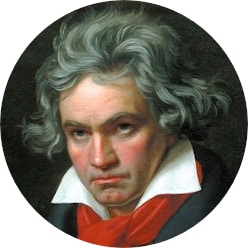
Ludwig van Beethoven
December 17, 1770 - Bonn (Germany) — March 26, 1827 - Vienna (Austria)
About
Born into obscurity, Beethoven charted a course as one of the greatest composers in history. Battling deafness, he triumphed over adversity to forge a revolutionary artistic path that bridged the gap between the Classical and Romantic periods. Though often misunderstood in his own lifetime, he has become one of the pillars of classical music, famously referred to as one of the “Three Bs.” His most enduring works, including the “Ode to Joy” chorus of his Ninth Symphony, celebrate the Enlightenment ideals of universal brotherhood and victory against tyranny.
Early Years: From Bonn to Vienna
Early years, family background, first education
Ludwig van Beethoven was born and baptized in Bonn, a provincial German town south of Cologne, in December 1770. His mother was a palace cook and his father, Johann, a musician of the local electorate. Johann gave his eldest son music lessons from an early age, though Ludwig, made to stand at the keyboard, was sometimes left in tears. Years later, Beethoven began studying composition with Christian Gottlob Neefe, the court organist in Bonn. Ludwig, Neefe wrote, “would surely become a second Wolfgang Amadeus Mozart if he were to continue as he has begun.”
Indeed, Johann van Beethoven attempted to turn his son into a child prodigy much as Leopold Mozart had done with his children. These tours, however, proved unsuccessful. Johann grew increasingly dependent on alcohol and possibly even violent toward his family. The situation became so dire that at the age of nineteen, Ludwig took the extraordinary step of placing himself as head of the household so he could support his two younger brothers.
Meeting the count of Waldstein; introduction to Haydn; first Viennese years; first success
Shortly before his twenty-second birthday, Beethoven left Bonn to seek his fortune in Vienna, the city that would become his lifelong home. With the introduction of an early patron, Count von Waldstein, he had secured composition lessons with Joseph Haydn. Before his departure, he was given a friendship book containing messages from companions and supporters. One of these, from Waldstein (later the dedicatee of his middle-period Waldstein piano sonata) left an auspicious note:
“Dear Beethoven: You are going to Vienna in fulfillment of your long-frustrated wishes. The Genius of Mozart is still mourning and weeping over the death of her pupil. She found a refuge but no occupation with the inexhaustible Haydn; through him she wishes once more to form a union with another. With the help of assiduous labour you shall receive Mozart’s spirit from Haydn’s hands.”
Beethoven's studies with Haydn were brief. Headstrong and at times overly sensitive to criticism, Beethoven wasn’t always a grateful pupil. He dedicated several works to Haydn but privately declared that he had never learned anything useful from him. Despite his bruised, youthful ego, Beethoven came to regard Haydn with reverence and affection. He later studied with Johann Georg Albrechtsberger, the best-known teacher of counterpoint in Vienna.
At twenty-four, Beethoven made his public debut in Vienna, performing his own concertos as well as works by Mozart and Haydn. This combination displayed Beethoven’s skills as a composer and performer—his improvisations made an especially strong impression—and signaled deference to those masters who preceded him. He established himself as a favorite among the music-loving aristocracy; early supporters included the Princes Lobkowitz and Lichnowsky.
In addition to patronage, publishing royalties, and concert fees, Beethoven relied on teaching to provide a steady income. Two of the pupils most associated with him are Ferdinand Ries and Carl Czerny, the latter of whom taught Franz Liszt. Other notable students include the Archduke Rudolph and Dorothea von Ertmann; after Beethoven’s death, she hosted salons devoted to performing his solo piano works.
In the ensuing years his fame as a performer continued to grow, aided by short tours and the occasional piano duel, and many considered him the finest pianist in Vienna. But as the century drew to a close, Beethoven longed also to make his mark as a composer.
Crisis and a Turning Point: The Beginning of the 19th Century
The first signs of deafness
The first two years of the nineteenth century were outwardly productive and happy ones for Beethoven. He had been living in Vienna, the musical capital of Europe, for nearly ten years, and his hard work was paying off. The premiere of his First Symphony was by most accounts a success. Soon after, the Burgtheater commissioned him to write his first (and only) ballet, The Creatures of Prometheus. A slew of well-received premieres and performances, as well as satisfying new personal and professional relationships, seemed to bode well for the composer as he entered his fourth decade.
Yet in the midst of this increasing success, Beethoven harbored the secret of his deafness, the cause of which remains a mystery. What he first described as mere “humming and buzzing” steadily grew more dire. In July 1801 he wrote to a friend,
“Let me tell you that my most prized possession, my hearing, has greatly deteriorated. ... You will realize what a sad life I must now lead, seeing that I am cut off from everything that is dear and precious to me.... I must withdraw from everything; and my best years will rapidly pass away without my being able to achieve all that my talent and my strength have commanded me to do. Sad resignation, to which I am forced to have recourse. Needless to say, I am resolved to overcome all this, but how is it going to be done?”
The despondent composer even penned a will and testament addressed to his brothers. In this 1802 letter, posthumously named the Heiligenstadt Testament after the town where it was written (he also composed most of his Second Symphony there), Beethoven affirms his decision to live for his art despite his disability. “Ah! how could I possibly quit the world,” he wrote, “before bringing forth all that I felt it was my vocation to produce?”
Beethoven’s comeback: the heroic period
A newly-resolved Beethoven produced a series of works in what has come to be called his “heroic” middle period. The first watershed compositions from these years include the Third Symphony and his dramatic rescue opera, Fidelio. The remaining years of this period saw the completion of other heroic, striving works including the Appassionata sonata and the Fifth Piano Concerto. Around this time, he completed one of his most popular compositions: Für Elise. Unpublished in his lifetime, it was discovered decades after Beethoven’s death; the identity of “Elise” remains a mystery.
The year 1808 saw Beethoven give one of his most famous fundraising concerts; indeed, it may be one of the most famous performances in all of classical music. The ambitious, hourslong program included the premieres of his Fifth and Sixth (“Pastoral”) Symphonies, his Fourth Piano Concerto, and the Choral Fantasy, a precursor to his Ninth Symphony.
For Beethoven, the final years of the middle period were eventful yet bittersweet. December 1813 saw the successful premiere of both his Seventh Symphony (audiences demanded an encore of the second movement) and Wellington’s Victory, a bombastic piece written to commemorate the Duke of Wellington’s triumph over Napoleon. His Eighth Symphony premiered two months later. These years proved to be the high-water mark of Beethoven’s acclaim in his lifetime, yet depression and doubts lingered. Artistically, he felt his artistic vision growing increasingly out of step with the demands of what he felt to be a shallow public.
Most alarmingly, by this time Beethoven’s deafness had grown worse. He used written conversation books to communicate, and his playing grew increasingly erratic. In April 1814 he gave his last public appearance as a featured pianist performing his “Archduke” Trio. Musician Louis Spohr wrote, “there was scarcely anything left of the virtuosity of the artist which had formerly been so greatly admired.”
Beethoven’s deafness forced him to turn inward. His output in these years was lean, yet this fallow time proved to be the transition between Beethoven’s middle and late periods; indeed, one scholar called this phase his “evolution toward the transcendental.”
The Late Period and Final Years
Beethoven’s third and final major stylistic period spanned roughly the last decade of his life. Beethoven imbued many of these works with increased intellectual depth and innovative musical structures, at times distilling musical elements into moments of profound expression. His veneration of old musical masters including Palestrina, Bach, and Handel manifests in these later works, particularly in the complex counterpoint and fugues of works such as the Missa solemnis and the Grosse Fuge for string quartet.
The sonatas and string quartets from this period are some of Beethoven’s most powerful. The massive Hammerklavier sonata, a “keyboard Ninth Symphony” in its own right, brought new levels of technical challenges and emotional range to the sonata. Beethoven’s transcendental seven-movement Opus 131 string quartet, one of the last pieces he completed, left composers like Franz Schubert wondering, “After this, what is left for us to write?”
Beethoven died on March 26, 1827, at the age of 56. Most theories say he died of liver failure possibly caused by alcoholism, hepatitis, or another illness entirely. Scientists and scholars continue to speculate on the ultimate cause of Beethoven’s demise, even after chemical analysis of his hair. His funeral was a major event, attended by over 10,000 mourners.
Beethoven’s work, a revolution and a cornerstone of classical music history
Initiating the transition towards Romanticism
Beethoven’s early works showed a clear deference to the Viennese Classical tradition codified by Haydn and Mozart, but he grew frustrated composing within these strictures. “I am only somewhat satisfied with my previous works” he famously mused. “From today on I will take a new path.”
And take a new path he did. In the ensuing decade, Beethoven churned out a stream of groundbreaking new compositions in genres including the symphony, string quartet, sonata, and concerto. These years became known as Beethoven’s “middle” period, a time of innovation and growth that saw the composer transition from Classical traditions into a firmly Romantic style. He expanded his piano music beyond mere virtuoso showpieces into massive, quasi-orchestral orchestral compositions. With these and other pieces, he pushed the boundaries of playability and comprehensibility, forcing both players and audiences to challenge themselves. Many of these works have become mainstays not only in the concert hall but in popular culture. 1802 saw the publication of the Fourteenth Piano Sonata, nicknamed “Moonlight” after a critic compared the famous slow movement to Lake Lucerne by moonlight. The Kreutzer violin sonata and Second Symphony soon followed, along with the Waldstein piano sonata. Waldstein, a grandiose and technically demanding work, was one of the earliest to exemplify Beethoven’s “heroic” middle style.
Beethoven’s symphonies
Though Beethoven’s innovations span genres, his development of the symphony remains his greatest musical legacy. Beginning with the Third Symphony, he expanded the range of these works in a way that broke with eighteenth century tradition (including Beethoven’s own First and Second Symphonies). Above all, his mature symphonies evoke a sense of evolution or psychological progression. Whether it is in the complex development of musical material or the transformation from minor to major keys, these works transcend the bounds of their predecessors. In some of his symphonies, Beethoven introduced extra-musical ideas to reinforce his narrative ideas. The Sixth Symphony, Pastoral, depicts Beethoven’s beloved nature, including a violent thunderstorm, while the Ninth introduces a sung poetic text.
Beethoven reached the apotheosis of his heroic style with his Third and Fifth Symphonies. Beethoven had planned to dedicate the Third to Napoleon Bonaparte, but grew enraged when Napoleon declared himself emperor. Beethoven saw this as a betrayal of Enlightenment ideals; in response, he angrily scratched Napoleon’s name from the score. He gave the work a new title, “Heroic Symphony, Composed to celebrate the memory of a great man,” from which the work has taken the nickname Eroica.
Beethoven’s Fifth Symphony has remained one of his most groundbreaking and popular works since its premiere (Carnegie Hall lists it as the second most-often performed symphony at the hall, behind only Brahms’ First Symphony). “More than any other single work,” wrote Richard Freed, “it was to set the pattern of ‘victory through struggle’ that would be effectively observed in dozens of well known symphonies” including those by Robert Schumann, Johannes Brahms, Anton Bruckner, Pyotr Ilyich Tchaikovsky, and Gustav Mahler. The writer E. T. A. Hoffmann, a contemporary of Beethoven’s, went further, exclaiming that the symphony “open[s] up for us the realm of the monstrous and the immeasurable. Glowing rays shoot through the deep night of this realm, and we become aware of giant shadows that wave up and down, close us in more and more narrowly, and annihilate everything in us except for the pain of infinite yearning….” In 1977, a recording of the first movement was selected for inclusion on the Voyager Golden Record, a phonograph record containing a broad sample of the images, common sounds, languages, and music of Earth.
His most famous symphony, and quite possibly the most famous work in all of classical music, must be the Ninth. Here Beethoven broke new ground with the inclusion of a full chorus and vocal soloists in the finale, set to Friedrich Schiller’s “Ode to Joy,” a powerful declaration of universal brotherhood. More than any of Beethoven’s other compositions, the Ninth had a profound influence on the works of future generations of composers. The Council of Europe adopted the “Ode to Joy” as an anthem to represent Europe, and it was later adopted by the European Union. On Christmas Day 1989, shortly after the fall of the Berlin Wall, Leonard Bernstein conducted a performance of the Ninth Symphony in West Berlin.
Beethoven’s concertos
Beethoven completed five piano concertos. The first three of these, completed during his first decade in Vienna, were written to establish both his virtuosic skills as a performer but also the seriousness of his compositional abilities. The Fourth and Fifth Concertos come from Beethoven’s middle, or “heroic,” period. He completed the Fifth, nicknamed “Emperor,” while Vienna was under siege from Napoleon’s armies; to protect his hearing, he fled to his brother’s cellar and covered his head with pillows to muffle the sounds of the bombardments. These last two remain some of the most performed piano concertos.
In addition to the five piano concertos, Beethoven composed a Violin Concerto, a cornerstone of the repertoire, as well as the Triple Concerto for violin, cello, and piano.
Fidelio: Beethoven’s sole opera
Fidelio received its inauspicious premiere in November 1805, when Vienna was under French occupation. The story depicts Leonore, disguised as a guard named Fidelio, as she attempts to free her husband, a political prisoner, from the prison ruled over by the despotic Pizarro. At the eleventh hour, as Leonore and her husband face certain death, they are rescued, the other prisoners are freed, and all celebrate Leonore’s bravery. This “rescue opera,” with its themes of brotherhood, devotion, and justice strongly appealed to Beethoven’s Enlightenment ideals.
Problems with the piece, along with the tenuous situation in occupied Vienna, led to the opera’s poor initial reception. Beethoven made numerous revisions, completing no fewer than four separate versions of the overture alone. An attempt to revive the opera failed, and it was only in 1814 that a third attempt to mount the opera found success. By this point, Beethoven was utterly fed up with Fidelio, writing to his new librettist that “this opera shall win me a martyr’s crown.”
Beethoven’s long shadow
The search for Beethoven’s successor began practically before the dirt had settled on his grave. One of the first proposed candidates was Franz Schubert, a fellow Viennese and ardent admirer of Beethoven’s who had served as a torchbearer at his funeral. According to Beethoven’s secretary, Anton Schindler, he had praised the “divine spark” in Schubert. Yet within two years the prolific “King of Song” also lay dead; he asked to be buried near Beethoven, his idol.
The French composer Hector Berlioz emerged as another possible successor. His programmatic five Symphonie fantastique showed a clear indebtedness to the inspiring but daunting older master. One article introduced Berlioz as the “third B” after Bach and Beethoven, though Johannes Brahms ultimately came to supplant Berlioz in this trio. Still others suggested the virtuoso Franz Liszt, a “grand-pupil” of Beethoven’s (he was taught by Carl Czerny). According to legend, Beethoven once heard Liszt perform as a child and kissed him on the forehead.
If anyone ultimately claimed the title of Beethoven’s successor, it was fellow German Johannes Brahms. In his four symphonies, Brahms carried on the tradition codified by Beethoven, though not without intense struggle. Paralyzed by the anxiety of influence, Brahms took more than two decades to complete his first symphony. He once despaired, “You can’t have any idea what it’s like always to hear such a giant marching behind you!” (It probably didn’t help that he kept a bust of Beethoven overlooking his piano.) When his First Symphony premiered, many compared it to Beethoven; some gave it the nickname “Beethoven’s Tenth.”
Regardless of who may have “succeeded” Beethoven, it is impossible to ignore his influence on nearly every major composer who has come after. Two hundred years after his death, his works remain firmly entrenched in the musical firmament. His remain some of the most programmed pieces in concert halls around the globe. Above all others, Beethoven has become the model of the singular artistic genius, overcoming adversity to give expression to his creative impulses.
Timeline of key events
- 1770: Ludwig van Beethoven is born in the German city of Bonn.
- 1775: Beethoven receives his first lessons from his father. The American Revolutionary War begins.
- 1778: Beethoven makes his public debut, performing “Various keyboard concertos and trios.”
- 1782: Beethoven’s first published work, Variations for the Keyboard on a March by Dressler, appears.
- 1789: The storming of the Bastille ignites the French Revolution.
- 1791: Wolfgang Amadeus Mozart dies at the age of 36; he is buried in a pauper’s grave.
- 1797: Viennese composer Franz Schubert is born.
- 1800: The First Symphony premieres and is published the following year.
- 1801: Completion of the Piano Sonata No. 14, Moonlight. Beethoven dedicated the piece to his pupil Countess Julie “Giulietta” Guicciardi.
- 1802: To escape the noise of Vienna, Beethoven spends six months in the small town of Heiligenstadt. There he writes the despairing “Heiligenstadt Testament” in response to his worsening deafness. Despite his inner turmoil, he completes his sunny Second Symphony, as well as the Opus 31 piano sonatas (including the “Tempest”).
- 1803: The United States purchases the Louisiana Territory from the French First Republic. French composer Hector Berlios is born.
- 1804: Napoleon Bonaparte crowns himself emperor of France.
- 1805: The Third Symphony, Eroica, premieres. Originally dedicated to Napoleon Bonaparte, later retracted when Napoleon crowned himself Emperor of France. The first version of Beethoven’s sole opera, Fidelio, premieres in Vienna while under French occupation.
- 1808: Premiere of the Fifth Symphony and the five-movement Sixth Symphony, Pastoral.
- 1809: Franz Joseph Haydn, mentor to Mozart and teacher of Beethoven, dies.
- 1810: Beethoven composes Für Elise in a single day. The identity of “Elise” remains unknown.
- 1811: Premiere of Beethoven’s fifth and final piano concerto, nicknamed “Emperor.” He finished writing the concerto in April 1809 while Vienna was under siege by Napoleon's armies. Franz Liszt is born.
- 1813: Premiere of the Seventh Symphony. Richard Wagner and Giuseppe Verdi are born.
- 1814: Premiere of the final version of Fidelio.
- 1815: Beethoven’s younger brother Caspar Carl dies; he begins a contentious five-year custody battle for his nephew, Karl. Napoleon’s defeat at the Battle of Waterloo and the signing of the Second Treaty of Paris bring the Napoleonic Wars to an end.
- 1817: Beethoven composes the Hammerklavier sonata, one of the most demanding solo works in the piano repertoire.
- 1821: Napoleon Bonaparte dies on the island of Saint Helena.
- 1823: Beethoven completes the 33 Variations on a Waltz by Anton Diabelli, perhaps his greatest contribution to the genre.
- 1824: Missa solemnis premieres in Saint Petersburg, Russia. “My primary goal in composing this grand Mass,” Beethoven wrote, “was to awaken and permanently instill religious feelings in both the singers and listeners.” The Symphony No. 9 in D minor premieres in Vienna. Today it is regarded as one of the crowning achievements of Western music.
- 1826: Beethoven completes the string quartets Opp. 131, 130, and 135, his final major works; his nephew Karl attempts suicide. Carl Maria von Weber, best known for his operas including Der Freischütz, dies.
- 1827: Beethoven dies. Nearly 10,000 mourners attend his funeral.
- 1833: German composer Johannes Brahms is born. Later in his life, many come to view him as Beethoven’s successor.